
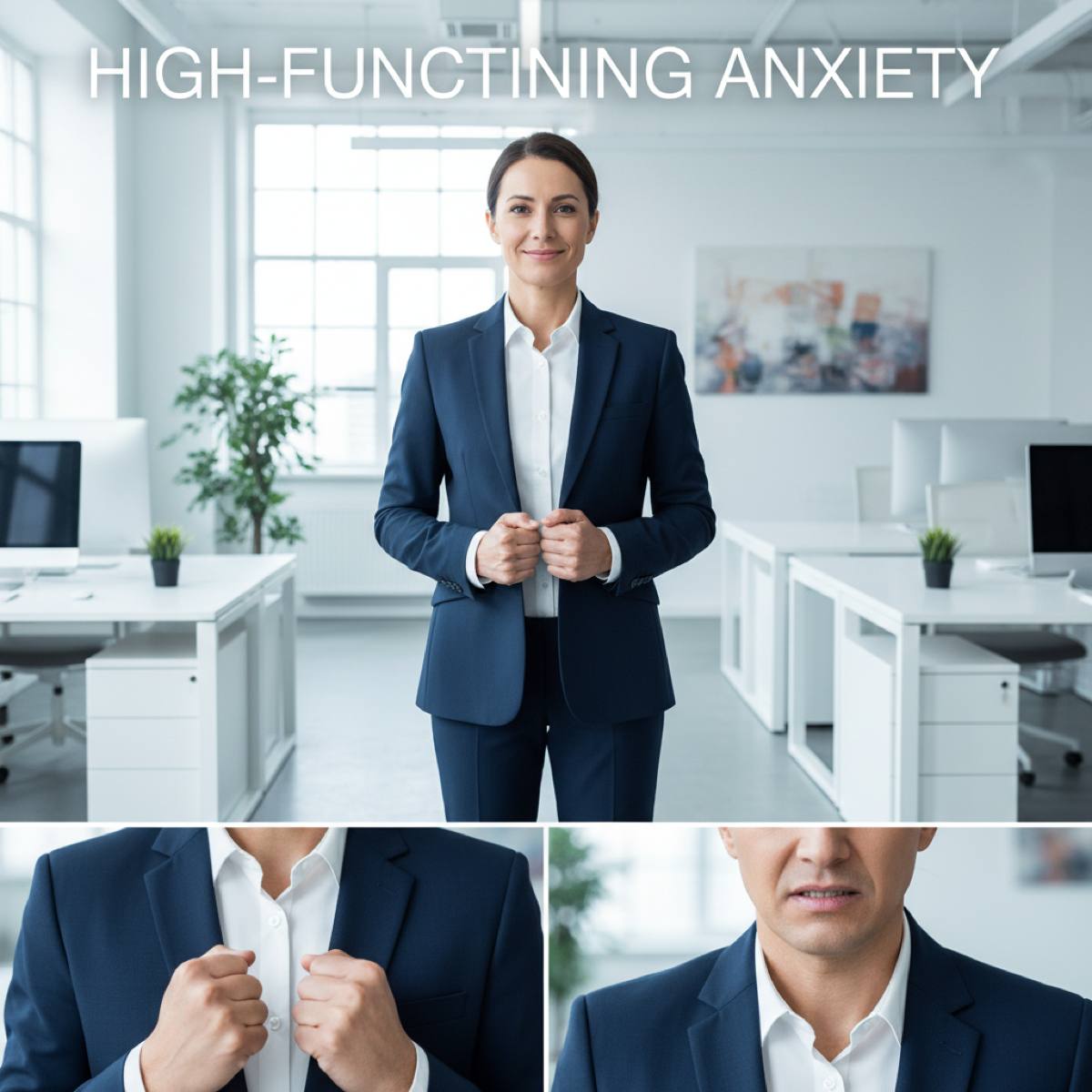
Person experiencing high-functioning anxiety

CBT for High-Functioning Anxiety

You look like you're coping. You're not.

Specialist therapy for professionals who perform brilliantly while quietly drowning. Evidence-based CBT. Online. Private.

The anxiety nobody sees (including, sometimes, you)

High-functioning anxiety isn't a formal clinical diagnosis. It's a widely recognised pattern where someone experiences significant anxiety — the racing thoughts, the physical tension, the constant worry — while continuing to function at a high level. Often an exceptionally high level.

From the outside, you look like a high-achiever. Organised. Driven. Reliable. Always on top of things.

From the inside, it feels more like this: a relentless internal engine of worry, self-doubt, and hyper-vigilance that never quite switches off. You've learned to channel the anxiety into productivity — and it's worked. But the cost is mounting.

The dangerous thing about high-functioning anxiety is that it's rewarded. Society applauds the person who always over-delivers and responds to emails at midnight. What it doesn't see is the knot in your stomach and the 3am mental rehearsal of tomorrow's meeting.

Recognise yourself?

The hidden cost of looking like you've got it together

The internal experience

  • Constant sense of dread that something will go wrong
  • Mental rehearsals of conversations on a loop
  • Difficulty making decisions — you see every risk
  • A persistent inner critic harsher than any boss
  • Restlessness — inability to relax without guilt
  • Sleep problems — can't switch off or waking at 4am

The external presentation

  • Most prepared person in the room — always
  • Volunteer for everything — if you do it, it's done properly
  • Respond to emails immediately — leaving them feels unbearable
  • Early for everything — being on time feels late
  • Rarely say no — guilt for days when you do
  • Appear calm and capable — expert at performing normality

The physical toll

  • Chronic muscle tension (shoulders, jaw, neck)
  • Digestive issues and IBS
  • Headaches and migraines
  • Fatigue that sleep doesn't fix
  • Getting ill more often
  • Heart palpitations, chest tightness

The high-functioning trap

Your anxiety has been disguised as your work ethic for so long that you're not sure where the anxiety ends and "you" begin.

  • "I'm not anxious enough." You compare yourself to people who can't leave the house and conclude you don't qualify. But anxiety doesn't need to be debilitating to deserve treatment.
  • "This is just how I'm wired." You've always been like this. But it's a pattern — and patterns can change.
  • "If I address the anxiety, I'll lose my edge." The research shows the opposite: reducing anxiety improves cognitive performance, creativity, and decision-making.
  • "I don't have time for therapy." You have time for the 3am worry spiral? Therapy is 50 minutes a week. Your anxiety is 24/7.

How CBT helps high-functioning anxiety

Understanding the anxiety cycle

Perceived threat → anxious thought → anxiety response → safety behaviour (over-preparation, checking) → temporary relief → perceived threat returns stronger. CBT maps your specific cycle and identifies where to interrupt it.

Challenging intolerance of uncertainty

CBT specifically targets intolerance of uncertainty — building your capacity to tolerate not knowing without spiralling.

Reducing safety behaviours

Over-preparation, checking, excessive list-making — these feel like coping strategies but they maintain the anxiety. CBT gradually reduces them in a structured way.

Worry postponement

Scheduling a defined time to worry and learning to redirect anxious thoughts outside that window. It sounds simple. It's remarkably effective.

Physiological de-escalation

Targeted interventions for resetting a chronically activated stress response — not just "take deep breaths."

The programme

The Anxiety Reset Programme

Phase 1: Assessment and formulation (sessions 1–2)

Comprehensive assessment using validated measures. Mapping your specific anxiety pattern — triggers, thoughts, behaviours, physical responses.

Phase 2: Understanding anxiety (session 3)

Psychoeducation about how anxiety works in the brain and body, why it persists, and why your current strategies are maintaining it.

Phase 3: Cognitive restructuring (sessions 4–6)

Identifying and challenging anxious thinking patterns. Intolerance of uncertainty, catastrophising, probability overestimation, mind-reading.

Phase 4: Behavioural experiments (sessions 5–9)

Gradually testing anxious predictions in real life. Reducing over-preparation, checking, and avoidance.

Phase 5: Consolidation and relapse prevention (sessions 10–12)

Embedding changes. Building a clear framework you can apply independently.

8–12 sessions · Weekly 50-minute video sessions · From £960

You've been managing this alone for long enough.

Book a free 15-minute exploratory call. It's private, it's confidential, and it's the first step toward feeling as good on the inside as you look on the outside.